20% off €45 or 15% off €35
10 lutein benefits & food sources
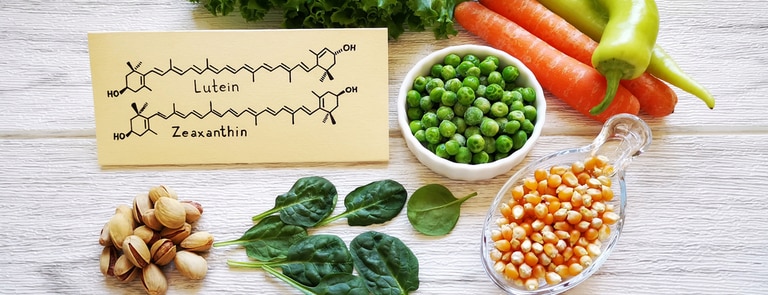
Lutein and zeaxanthin, what are they? And what's their importance? Learn the benefits of lutein for your eye, skin and brain health in our guide - plus lots more.
Summary
1How much lutein should you have a day?
If you’re looking to use lutein to support eye health, then it’s recommended to take somewhere between 6-20mg per day. In addition, one study has...
210 lutein benefits
We’ll run you through the details on how lutein can be beneficial for our eye health as well as our skin and brain! Using lutein for eye health...
3What lutein supplements are available?
We’ve listed the most common forms of lutein supplements for you below. 1. Lutein tablets 2. Lutein capsules 3. Lutein gummies...
Lutein, found in green veggies, is known for its protective effect on eye health – now research shows it can help support your brain, too.
If you’re looking to boost your brainpower, upping your greens might be the way to go as they often contain lutein.
Lutein has long been celebrated for its protective benefits on your eyes.1
Now, neuroscientists are exploring how lutein can be good for our brain too.
Research by the University of Illinois Urbana-Champaign found the nutrient is able to accumulate in brain tissue where it fixes itself to cell membranes and plays a protective role.2
But exactly how does this translate into better brain functions?
What is lutein?
Before delving into detail, let’s start with the basics. What is lutein? Putting it simply, lutein is a type of vitamin.
It falls under the carotenoid category, which means it’s related to beta-carotene and vitamin A.
Carotenoids are also a type of plant pigment that gives fruits and vegetables their colour.3
What is zeaxanthin?
Likewise, zeaxanthin is another type of carotenoid, a pigment that brings about the yellow/red colour of plants.
Structurally, the two are very similar with only a small difference in the atomic arrangement.4
How much lutein should you have a day?
If you’re looking to use lutein to support eye health, then it’s recommended to take somewhere between 6-20mg per day.5,6
In addition to this, one study has shown that 10mg of lutein and 2mg of zeaxanthin supplements lead to a huge reduction in the progression to advanced age-related macular degeneration.7
10 lutein benefits
So we know lutein is good for us, but how exactly?
We’ll run you through the details on how lutein can be beneficial for our eye health as well as our skin and brain!
Using lutein for eyes and eye health
- Can support age-related macular degeneration
Otherwise known as AMD, taking lutein and zeaxanthin supplements could help to protect against the progression of this condition which can lead to blindness.8,9,10 - May help with cataracts
Another one of the lutein benefits is that it may slow the onset of cataracts (cloudy patches that can appear at the front of your eye) – whether through supplements or by eating lutein rich foods.11,12 - Support with diabetic retinopathy
A complication of diabetes, diabetic retinopathy is where the back of the eye becomes damaged by high blood sugar levels, which can lead to blindness if left undiagnosed.13
When studying animals with diabetes, researchers found that those who consumed a lutein and zeaxanthin supplement reduced signs of oxidative stress which can damage the eyes.14,15,16 - Help with eye detachments
Similarly, when studying rats with eye detachments, researchers found that an injection of lutein lead to 54% less cell death than the rats who were injected with corn oil instead.17 - Supports problems with uveitis
Uveitis is the inflammation of the middle layer of the eye (the uvea or uveal tract), which can cause pain and may affect your vision.
However, studies show that supplementation of lutein and zeaxanthin may help to reduce any inflammation that is involved in the process.18,19,20
Other lutein benefits for your health
As well as all the above benefits for your eye heath, lutein and zeaxanthin may also have beneficial properties for your skin.
In particular, the antioxidant effects of the two assist in protecting your skin from the sun’s UV rays.21
When looking at studies on this area, rats who were given a 0.4% enriched diet of lutein and zeaxanthin showed less UVB-induced skin issues than the rats that were given a smaller dose of 0.04%.22
But it doesn’t end there.
Both lutein and zeaxanthin aid your body to protect its proteins, fats and DNA from stressors, while also assisting your body to recycle another antioxidant called glutathione.23
One 2016 study looking at the effect of lutein on cardiometabolic health found that a higher dietary intake and higher blood concentrations of lutein were associated with better cardiometabolic health.24
If you’re struggling to finish a crossword, getting more greens is a smart choice.
In a 2017 study of adults aged 25-45, scientists found that older participants with higher levels of lutein in their diets had the same cognitive responses as younger volunteers when completing a task that tested their attention span.25
Handpicked content: Go green to boost your wellbeing
According to a 2017 University of Georgia study, those who ate more lutein found memory-related tasks easier than those who ate less.26
Lutein can also help your brain retain particular information.
The University of Illinois study found that consuming high levels of lutein helped to preserve what is known as ‘crystallised intelligence’ – the ability to remember skills you have acquired over your lifetime.27
Getting enough lutein in your daily diet can increase the speed at which your brain responds to something.
In a 2014 study published in the journal PLOS One, scientists discovered that people who took a daily lutein supplement were able to react to visual information – what they saw in front of them – faster than those who did not.28
Handpicked content: Best vitamins for brain & memory
12 lutein foods
Your body doesn’t naturally produce lutein, so you need to include the right sources in your diet to reap the benefits.
The highest levels of the nutrient can be found in:

1. Kale
In 100g of kale, there is approximately 6260 µg of lutein and zeaxanthin.29
2. Spinach
In 100g of baby spinach, there is approximately 6020 µg of lutein and zeaxanthin.30
For some vegetables, the cooking process increases levels of lutein. For example, there’s almost double the amount in cooked spinach compared to raw.

3. Parsley
In 100g of parsley, there is approximately 5560 µg of lutein and zeaxanthin.31
4. Peas
In 100g of peas, there is approximately 2480 µg of lutein and zeaxanthin.32

5. Broccoli
In 100g of broccoli, there is approximately 745 µg of lutein and zeaxanthin.33
6. Honeydew melon
In 100g of honeydew melon, there is approximately 27 µg of lutein and zeaxanthin.34

7. Red peppers
In 100g of red peppers, there is approximately 51 µg of lutein and zeaxanthin.35
8. Kiwis
In 100g of kiwis, there is approximately 122 µg of lutein and zeaxanthin.36

9. Grapes
In 100g of grapes, there is approximately 72 µg of lutein and zeaxanthin.37
10. Asparagus
In 100g of asparagus, there is approximately 710 µg of lutein and zeaxanthin.38

11. Romaine lettuce
In 100g of romaine lettuce, there is approximately 1730 µg of lutein and zeaxanthin.39
12. Pistachio nuts
In 100g of pistachio nuts, there is approximately 2900 µg of lutein and zeaxanthin.40
When to take lutein supplements
It’s preferable to take lutein supplements with a meal as they’re often best absorbed with a source of fat.
What lutein supplements are available?
Interested in taking some lutein supplements?
If you’re not sure what’s out there and which is best for you, don’t worry.
We’ve listed the most common forms of lutein supplements for you below.
Arguably the most common type of lutein supplement is lutein tablets.
Available in a selection of strengths, from 6mg to 10mg lutein tablets are great if you have no problem with swallowing pills.
As well as tablets, you can also try lutein capsules.
Easy to swallow and often with a rapid release formula, you can find lutein capsules in strengths from 6mg to 20mg.
If swallowing both tablets and capsules is tricky for you, thankfully there’s another solution… lutein gummies!
While some can be lower in strength, lutein gummies come in a range of flavours, from zingy orange to beautiful blueberry.
Side effects of lutein
Fortunately, there have been little reported side effects to taking lutein and zeaxanthin supplements.
One particular study completed on a large scale found the only notable yet mild side effect was a slight yellowing of the skin – but this is not considered harmful.41
Is lutein suitable for everyone?
Since lutein and zeaxanthin have an excellent safety profile, a moderate supplementation of the two should be safe for most people.
Studies have also suggested that prenatal cartenoid supplementation of both lutein and zeaxanthin could be beneficial for pregnant women, but more research is needed in this area.42
The final say
Since both lutein and zeaxanthin are antioxidants, they come with a range of benefits for our health.
Whether you choose to increase your intake through eating lutein-rich foods or you opt for a supplement, doing so could result in some improvements to your eye health, brain health and even skin health.
The advice in this article is for information only and should not replace medical care. Please check with your GP or healthcare professional before trying any supplements, treatments or remedies. Food supplements must not be used as a substitute for a varied and balanced diet and a healthy lifestyle.
Last updated: 8 September 2021
- https://www.ncbi.nlm.nih.gov/pubmed/19168000
- https://www.ncbi.nlm.nih.gov/pmc/articles/PMC5138207/
- https://www.ncbi.nlm.nih.gov/pmc/articles/PMC6164534/
- https://www.ncbi.nlm.nih.gov/pmc/articles/PMC4321000/
- https://www.ncbi.nlm.nih.gov/pubmed/7933422/
- https://www.ncbi.nlm.nih.gov/pubmed/22858124
- https://www.ncbi.nlm.nih.gov/pmc/articles/PMC4636082/
- https://www.ncbi.nlm.nih.gov/pubmed/21899805
- https://www.ncbi.nlm.nih.gov/pubmed/11226974/
- https://www.ncbi.nlm.nih.gov/pubmed/7933422
- https://www.ncbi.nlm.nih.gov/pubmed/16936087
- https://www.ncbi.nlm.nih.gov/pubmed/16723441/
- https://www.nhs.uk/conditions/diabetic-retinopathy/
- https://www.ncbi.nlm.nih.gov/pubmed/16934681
- https://www.ncbi.nlm.nih.gov/pmc/articles/PMC2850533/
- https://www.ncbi.nlm.nih.gov/pubmed/18385086
- https://www.ncbi.nlm.nih.gov/pmc/articles/PMC3536954/
- https://www.ncbi.nlm.nih.gov/pmc/articles/PMC4838793/
- https://www.ncbi.nlm.nih.gov/pubmed/16723471
- https://www.ncbi.nlm.nih.gov/pmc/articles/PMC3217882/
- https://www.ncbi.nlm.nih.gov/pubmed/19168000
- https://www.ncbi.nlm.nih.gov/pubmed/12880433/
- https://pubmed.ncbi.nlm.nih.gov/26762372/
- https://www.frontiersin.org/articles/10.3389/fnagi.2017.00183/full
- https://www.cambridge.org/core/journals/journal-of-the-international-neuropsychological-society/article/
- https://www.frontiersin.org/articles/10.3389/fnagi.2017.00183/full
- https://www.ncbi.nlm.nih.gov/pubmed/25251377
- https://www.ncbi.nlm.nih.gov/pubmed/25251377
- https://fdc.nal.usda.gov/fdc-app.html#/food-details/323505/nutrients
- https://fdc.nal.usda.gov/fdc-app.html#/food-details/1750352/nutrients
- https://fdc.nal.usda.gov/fdc-app.html#/food-details/170416/nutrients
- https://fdc.nal.usda.gov/fdc-app.html#/food-details/170419/nutrients
- https://fdc.nal.usda.gov/fdc-app.html#/food-details/170379/nutrients
- https://fdc.nal.usda.gov/fdc-app.html#/food-details/169911/nutrients
- https://fdc.nal.usda.gov/fdc-app.html#/food-details/170108/nutrients
- https://fdc.nal.usda.gov/fdc-app.html#/food-details/1102667/nutrients
- https://fdc.nal.usda.gov/fdc-app.html#/food-details/1102665/nutrients
- https://fdc.nal.usda.gov/fdc-app.html#/food-details/1103106/nutrients
- https://fdc.nal.usda.gov/fdc-app.html#/food-details/170184/nutrients
- https://www.frontiersin.org/articles/10.3389/fnagi.2016.00297/full
- https://www.ncbi.nlm.nih.gov/pubmed/23644932/
- https://trialsjournal.biomedcentral.com/articles/10.1186/s13063-021-05244-2
Related to this article