20% off €45 or 15% off €35
 Track an order
 Manage account
 Buy It Again
 Favourites
 Rewards
 Find a store

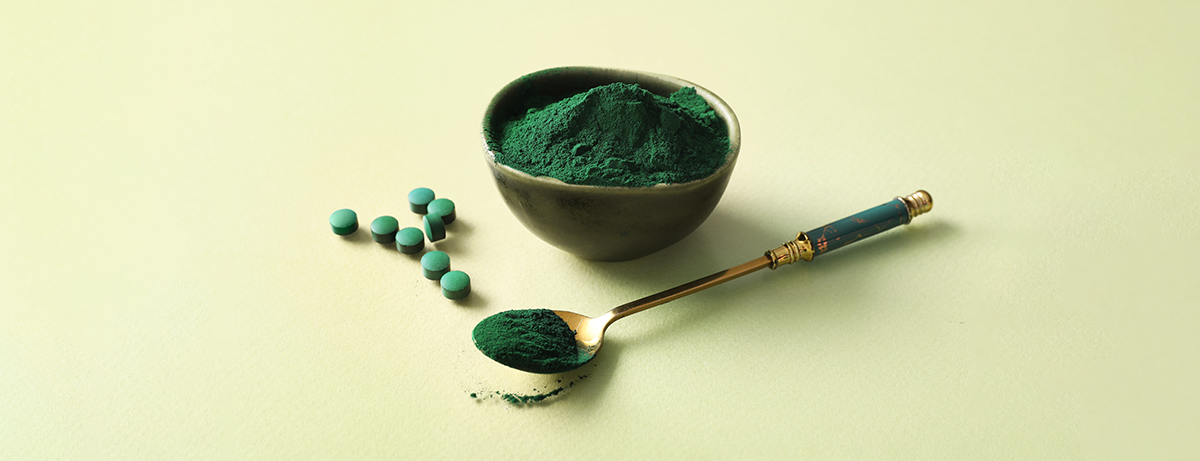
Everyone’s talking about spirulina. But what is it really and why are so many people adding it to their routine? Let’s take a closer look...
Summary
1What is spirulina?
It’s a naturally occurring blue-green algae that grows in freshwater environments. It’s even been studied as an alternative protein source to meat.
2What’s spirulina’s nutrition value?
It’s nutrient rich and has a range of vitamins and minerals including iron, magnesium, vitamin C and several B vitamins.
3Does spirulina help with energy?
Spirulina has been scientifically studied for its impact on fatigue, but the evidence is still developing.
You’ve probably spotted spirulina turning smoothies that deep, vivid green all over your social feed. It’s often labelled a ‘superfood’ but this blue-green algae is more than just a trend – it’s been used for centuries and is packed with nutrients that have people taking a closer look.
It’s got a distinctive taste (we’ll be honest… it’s pretty earthy), but its nutritional profile is what really gets people talking. From its naturally high protein content to the way it fits into modern wellness routines, spirulina has built a bit of a reputation. So, what’s behind the growing interest in spirulina and could it have a place in your routine?
What is spirulina?
Spirulina is a naturally occurring blue-green algae that grows in freshwater environments.1 Today, it’s carefully cultivated in controlled pools in warmer climates such as Mexico, India and China.
Once harvested, spirulina is filtered, washed and gently dried into a powder, without anything being added. It’s a simple process that helps preserve its naturally occurring nutrients.2 It grows fast and can be produced in a way that has a very low impact on the planet, so it’s been explored as an alternative protein source to meat. Weight for weight, it has a higher protein and iron content than beef,3 but it may not be a good substitute for those who enjoy a steak...
Despite feeling like a modern wellness trend, spirulina has been around for a long time and has even been explored by NASA as a nutrient-dense food for space missions.4
What are the nutritional benefits of spirulina?
Spirulina is known for being nutrient-rich.5,6 It contains:
- protein making up between 50-70% of its dry weight and including all essential amino acids
- a range of vitamins and minerals including iron, magnesium, vitamin C and several B vitamins. These nutrients all play roles in everyday processes in the body, including how we release and use energy from food
Is spirulina good for energy?
Several of the nutrients found in spirulina (such as iron, magnesium, vitamin B6, thiamin, riboflavin and niacin) contribute to normal energy-yielding metabolism, which is where your body converts the food you eat into usable energy.
As spirulina contains a combination of these nutrients, it’s often explored as a convenient way to add a little extra nutritional support to your day, especially if you’re looking to feel more on top of things. Spirulina has been scientifically studied for its impact on fatigue, but the evidence is still developing and more studies are needed to fully understand its effects. One study did find an improvement in mental and physical fatigue when men took 3g of spirulina daily for eight weeks, however.8

Why do people take spirulina as part of their routine?
People choose spirulina for different reasons like:
- a natural way of adding variety to their nutrient intake
- supporting an active lifestyle
- exploring plant-based sources of protein and micronutrients
It’s not about quick fixes but more about small additions that may complement a balanced diet. Emerging research suggests that spirulina may help with weight management, with studies showing that appetite’s reduced and response to exercise is increased by spirulina.8,9
Chlorella vs spirulina: what’s the difference?
Spirulina is often compared to another algae, chlorella.10 While both are nutrient-rich, there are a few differences:
- spirulina is higher in protein and contains all essential amino acids
- chlorella tends to provide more omega-3 fatty acids
- both contain a range of vitamins and minerals, including B vitamins
They’re often used in similar ways, so it usually comes down to personal preference.
How to take spirulina
Spirulina is available in powder, tablet or capsule form. If you’re using the powder, a small amount goes a long way. It’s commonly added to smoothies (try pairing with mango or pineapple to balance the flavour), juices, protein shakes, energy balls or homemade snacks.
Spirulina FAQs
There’s no official recommended daily intake for spirulina, but studies have explored amounts ranging from 1-8g per day. As with any supplement, it’s best to follow the guidance on the product label and speak to a healthcare professional if you’re unsure.
It’s not suitable if you’re pregnant, breastfeeding or have an allergy to it. If you’re taking medication or have a health condition, it’s always worth checking with your GP before taking a new supplement.
It typically has a strong, earthy and savoury taste. That’s why most people add it to smoothies, juices and sometimes pesto to disguise the taste.
The final say
Spirulina might not be the first thing you reach for but that’s part of its appeal. Whether you’re blending it into a smoothie or trying it in a new recipe, it’s an ingredient that adds a burst of colour. Spirulina is rich in nutrients and has a low impact on the environment, so it’s easy to see why it continues to spark curiosity.
Stay in the world of discovering new ingredients and take a look at our favourite matcha powders for making your own matcha latte at home and unlock cinnamon's spicy secrets.
Disclaimer – This article provides informational advice and is not a substitute for medical care. Working with experts for accuracy, we take great care to ensure the information is up-to-date and relevant. However, you should always consult your GP or healthcare professional before using supplements or alternative products, particularly if you have medical conditions or are under supervision.
1. Rahnama I, Arabi SM, Chambari M, Bahrami LS, Hadi V, Mirghazanfari SM, Rizzo M, Hadi S, Sahebkar A. The effect of Spirulina supplementation on lipid profile: GRADE-assessed systematic review and dose-response meta-analysis of data from randomized controlled trials. Pharmacol Res. 2023 Jul;193:106802.
2. MEDICINES, N. 2025. Blue-Green Algae [Online]. Therapeutic Research. Available: https://naturalmedicines.therapeuticresearch.com/Data/ProMonographs/Blue-Green-Algae#drug-interactions [Accessed 24/03/26].
3. Tzachor A, Smidt-Jensen A, Ramel A, Geirsdóttir M. Environmental Impacts of Large-Scale Spirulina (Arthrospira platensis) Production in Hellisheidi Geothermal Park Iceland: Life Cycle Assessment. Mar Biotechnol (NY). 2022 Oct;24(5):991-1001. doi: 10.1007/s10126-022-10162-8. Epub 2022 Sep 7. Erratum in: Mar Biotechnol (NY). 2022 Dec;24(6):1177. Environmental Impacts of Large-Scale Spirulina (Arthrospira platensis) Production in Hellisheidi Geothermal Park Iceland: Life Cycle Assessment - PMC
4. Karkos PD, Leong SC, Karkos CD, Sivaji N, Assimakopoulos DA. Spirulina in clinical practice: evidence-based human applications. Evid Based Complement Alternat Med. 2011;2011:531053. Spirulina in Clinical Practice: Evidence-Based Human Applications - PMC
5. Spínola MP, Mendes AR, Prates JAM. Chemical Composition, Bioactivities, and Applications of Spirulina (Limnospira platensis) in Food, Feed, and Medicine. Foods. 2024 Nov 17;13(22):3656. Chemical Composition, Bioactivities, and Applications of Spirulina (Limnospira platensis) in Food, Feed, and Medicine - PubMed
6. Bortolini DG, Maciel GM, Fernandes IAA, Pedro AC, Rubio FTV, Branco IG, Haminiuk CWI. Functional properties of bioactive compounds from Spirulina spp.: Current status and future trends. Food Chem (Oxf). 2022 Sep 19;5:100134. doi: 10.1016/j.fochms.2022.100134. PMID: 36177108; PMCID: PMC9513730.
7. Johnson M, Hassinger L, Davis J, Devor ST, DiSilvestro RA. A randomized, double blind, placebo controlled study of spirulina supplementation on indices of mental and physical fatigue in men. Int J Food Sci Nutr. 2016;67(2):203-6. A randomized, double blind, placebo controlled study of spirulina supplementation on indices of mental and physical fatigue in men - PubMed
8. Zeinalian, R., et al. (2017). "The effects of Spirulina Platensis on anthropometric indices, appetite, lipid profile and serum vascular endothelial growth factor (VEGF) in obese individuals: a randomized double blinded placebo controlled trial." BMC Complement Altern Med 17(1): 225.
9. Hossein, N., et al. (2025). "Spirulina supplementation and circuit resistance training (CRT) reduce serum asprosin and appetite and improve energy balance in men with obesity and overweight." Hormones (Athens) 24(1): 23-31.
10. Wang CA, Onyeaka H, Miri T, Soltani F. Chlorella vulgaris as a food substitute: Applications and benefits in the food industry. J Food Sci. 2024 Dec;89(12):8231-8247. doi: 10.1111/1750-3841.17529. Epub 2024 Nov 18. Chlorella vulgaris as a food substitute: Applications and benefits in the food industry - PMC
Related to this article