20% off €45 or 15% off €35
 Track an order
 Manage account
 Buy It Again
 Favourites
 Rewards
 Find a store


With the help of our seasoned H&B food team and in-house scientists, we’re diving into everything Celtic salt and asking what it might bring to the table
Summary
1What are the benefits of Celtic salt?
“Celtic sea salt contains a higher content of trace minerals like magnesium, calcium and potassium compared to normal salt."
2Celtic salt vs. Himalayan salt
As well as its dusky pink hue, Himalayan salt differs in origin, flavour and mineral content.
3Celtic salt vs. sea salt
“Celtic sea salt differs in mineral content from regular table salt due to its harvesting techniques."
Having piled up over 36 million posts on TikTok, Celtic salt is certainly shaking up the food world. But how much more nutritious can salt really be than... salt? We asked a H&B nutritionist Jenna Burke and category manager Launa Humphreys to sprinkle us with their knowledge. So, let’s get into the nitty-gritty of this trending ingredient.
What is Celtic salt?
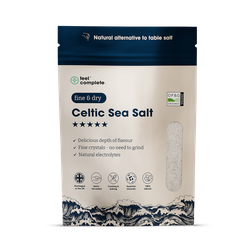
Although the name might suggest it hails from the Celtic Sea, it’s actually hand-harvested from the coasts of France and Portugal. The nod to the Celts actually comes from the traditional collection methods of sun and wind evaporation.
“The seawater is collected from tidal pools and channelled into ‘oeillets’, shallow, clay-lined salt marshes, to allow the water to evaporate and salt to crystallize, maintaining its rich mineral content,” says Jenna.1 You might also see it called 'sel gris', French for grey salt, due to its tonal grey colouring from the minerals.
Feel Complete
What are the benefits of Celtic salt?
“Celtic sea salt contains a higher content of trace minerals like magnesium, calcium and potassium compared to normal salt,” says Jenna. “Magnesium, calcium and potassium are well-established beneficial minerals which are involved in the maintenance of healthy bones, muscle function, nerve transmission and the regulation of blood pressure,” she says.2-4
Launa was really excited to get this trending product stocked up on our shelves and online. Here are a few reasons why...
“Celtic sea salt actually contains slightly less sodium per serving compared to regular table salt”
Celtic salt is less processed
“Celtic sea salt is less processed than other salts and contains a variety of trace minerals including magnesium, potassium, calcium, iron and zinc,” agrees Launa.
Celtic salt has lower sodium content
“Despite its bold flavour, a pinch of Celtic salt has slightly less sodium content vs. table salt.”
Celtic salt can help with hydration
“The presence of trace minerals in Celtic salt can help balance electrolyte levels and promote better hydration.”
So that’s what all the fuss is about. But remember these studies are small and need to be taken with a pinch of salt (ahem). “Although the nutritional profile of Celtic sea salt sounds promising, the evidence is lacking in regard to any additional health benefits associated with the consumption of Celtic sea salt over regular table salt, as the minerals are only present in trace amounts,” says Jenna.
“However, the composition of Celtic sea salt doesn’t allow for adequate accessibility to the amount of minerals required by the body. So, alternative sources such as whole fruits, vegetables and grains are great options as there’s less worry of over-consuming salt.”
“While regular table salt is rigorously processed, Celtic sea salt is hand-harvested”
Celtic salt vs. Himalayan salt
As well as its dusky pink hue, Himalayan salt differs in origin, flavour and mineral content. As it’s mined from the mountains in the Punjab region of Pakistan, you can imagine how this might make it different from the European shores where Celtic salt is found. Himalayan salt has a more subtle flavour and contains magnesium, calcium, potassium, iron (like its Celtic sibling), as well as other trace minerals like strontium and molybdenum.5
Celtic salt vs. sea salt
“Celtic sea salt differs in mineral content from regular table salt due to its harvesting techniques. While regular table salt is rigorously processed and refined, Celtic sea salt is hand-harvested from France and Portugal,” says Jenna.
Feel Complete
The final say
The mineral profile sounds promising – but is it worth its salt? Compared to regular table salt, Celtic-harvested varieties certainly retain more magnesium, calcium and potassium. So if you’re already seasoning your dishes, Celtic salt is a way to up your gourmet game.
Think of it like choosing a wholegrain loaf over refined white bread, baking with the finest Belgian chocolate or choosing freshly squeezed orange juice over concentrate. Although Celtic salt will enhance your recipes, it still does have a high sodium content. Check out how low magnesium affects your blood sugar.
Disclaimer – This article provides informational advice and is not a substitute for medical care. Working with experts for accuracy, we take great care to ensure the information is up-to-date and relevant. However, you should always consult your GP or healthcare professional before using supplements or alternative products, particularly if you have medical conditions or are under supervision.
- Imen Ben Fredj (2024). Celtic Sea Salt: A closer look to its benefits, origins & uses. [online] Isle of Skye Sea Salt Company. Available at: https://www.isleofskyeseasalt.co.uk/blogs/news/celtic-sea-salt-a-closer-look-to-its-benefits-origins-uses [Accessed 27 Sep. 2024].
- EFSA NDA Panel (EFSA Panel on Dietetic Products, Nutrition and Allergies), 2013. Scientific Opinion on the substantiation of a health claim related to magnesium and contribution to normal development of bone pursuant to Article 14 of Regulation (EC) No 1924/2006. EFSA Journal 2013; 11(7):3331, 10 pp. doi:10.2903/j.efsa.2013.3331
- EFSA NDA Panel, Turck D, Bresson J-L, Burlingame B, Dean T, Fairweather-Tait S, Heinonen M, Hirsch-Ernst KI, Mangelsdorf I, McArdle H, Naska A, Neuhäuser-Berthold M, Nowicka G, Pentieva K, Sanz Y, Sjödin A, Stern M, Tomé D, Van Loveren H, Vinceti M, Willatts P, Martin A, Strain S (JJ) and Siani A, 2016. Scientific opinion on calcium and contribution to the normal development of bones: evaluation of a health claim pursuant to Article 14 of Regulation (EC) No 1924/2006. EFSA Journal 2016; 14(10):4587, 9 pp. doi:10.2903/j.efsa.2016.4587
- EFSA Panel on Dietetic Products, Nutrition and Allergies (NDA); Scientific Opinion on the substantiation of health claims related to potassium and maintenance of normal muscular and neurological function (ID 320, 386) and maintenance of normal blood pressure (ID 321) pursuant to Article 13(1) of Regulation (EC) No 1924/2006. EFSA Journal 2010; 8(2):1469. [17 pp.]. doi:10.2903/j.efsa.2010.1469.
- Fayet-Moore F, Wibisono C, Carr P, Duve E, Petocz P, Lancaster G, et al. An Analysis of the Mineral Composition of Pink Salt Available in Australia. Foods. 2020 Oct 19;9(10):1490.
Related to this article