Track an order
 Manage account
 Buy It Again
 Favourites
 Rewards
 Find a store


Struggling with loose skin after weight loss? It’s more common than you think. From simple everyday habits to in-clinic treatments, our expert explains how to support firmer, happier skin
Summary
1Why do you get loose skin after weight loss?
Loose skin occurs when stretched skin can’t tighten at the same pace as weight loss, especially after long-term or rapid weight changes...
2Can loose skin tighten over time?
Loose skin can improve gradually, particularly with habits that support muscle tone, though results take time...
3What can help improve the appearance of loose ski
Strength training, supportive skincare and professional treatments may all help improve firmness...
If you’ve recently lost a significant amount of weight and spotted saggy patches of skin that don’t seem to spring back, you’re not alone. Loose skin after weight loss is common but that doesn’t make it any less frustrating. And after all the effort you’ve put into your journey, it can feel like an unexpected final hurdle.
To get a clearer picture of why loose skin happens and what you can do to help tighten it, we spoke to our in-house nutritionist Sarah Harris, an expert in weight management and behaviour change. She always encourages people to pause and appreciate just how far they’ve come, saying: “Loose skin is a sign that your body has changed in a positive way. It’s normal and it can improve over time.” So, let’s break down what’s behind loose skin, how you can help it recover and the steps that can make you feel more at home in your body again.
What causes loose skin after weight loss?
Loose skin after weight loss is usually linked to the natural structure of the skin. Proteins like collagen and elastin give skin its firmness and flexibility, but these can weaken over time due to age, sun exposure or smoking.1 When you lose weight quickly or after years of carrying extra weight, the skin may not shrink at the same pace, which is why areas like the stomach, arms and thighs tend to show sagging more clearly.2 After substantial weight loss, especially at a rapid rate or after bariatric surgery, the fat beneath the skin can lose some of its ability to retract, which may leave it looking loose or saggy.2
How to tighten loose skin
1. Use plumping creams and moisturisers
Plumping creams won’t completely remove loose skin but they may help improve texture, smoothness and hydration. Ingredients such as hyaluronic acid and nourishing oils can help plump the skin’s surface.3
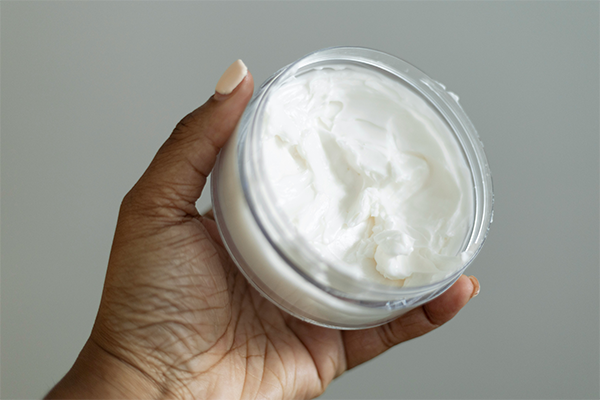
Caffeine is another ingredient that has been shown to offer a temporary firming effect to skin by affecting circulation and reducing excess fluid, but the effects are short-lived.4 Retinol can also help improve the appearance of skin over time but results can take several weeks to show.3 As Sarah puts it, “consistency matters more than the product you choose.”
2. Strengthen your muscles
Resistance training builds muscle, which may help you feel like your skin is appearing firmer and more supported. Research shows that strength training improves muscle mass and overall body composition, which can seem to enhance the appearance of loose skin over time.5,6 The best part? You don’t need a gym membership to start. Simple exercises like squats, planks or using resistance bands at home can be enough to build muscle mass.
3. Explore non-surgical treatments
If you want more targeted results, several non-invasive treatments encourage your skin to produce more collagen:
- microneedling: this promotes collagen and elastin regeneration and has been shown to improve skin tightness7
- laser therapy: can improve firmness and texture when carried out by qualified practitioners8
- radiofrequency treatments: help stimulate collagen using heat and can help tighten skin without surgery9
- ultrasound treatments: target deeper layers of skin to support lifting and tightening10
These options often require multiple sessions and can be costly, so always speak to a trained professional first.
4. Surgical options
In extreme circumstances (such as for significant loose skin), surgery may be the most effective option. Procedures like tummy tucks, arm lifts or thigh lifts remove excess skin and reshape the area for a firmer appearance.11 Surgery is more invasive, requires recovery time and may leave scars, so it’s usually considered a last resort. In the UK, the NHS may cover loose skin removal surgery in specific cases, such as when skin causes functional problems or severe emotional distress.12 Your GP can advise on eligibility and next steps.
Can you prevent loose skin?
There’s no guaranteed way to completely prevent loose skin, but losing weight gradually and including strength training in your routine may help your skin maintain elasticity as your body changes.
The final say
Loose skin after weight loss can feel like an unwelcome surprise, but it’s actually a sign of just how far you’ve come. While you might not be able to remove loose skin completely without medical help, there are plenty of ways to improve elasticity, firmness and overall confidence. Whether you try simple at-home steps or explore professional treatments, be patient with your body as it adapts – your skin is simply catching up.
Want to take some of these tips further? Check out these handy articles about why flexibility is so important for muscle strength, why rest is essential for muscle growth and how protein supports your muscles and movement.
Disclaimer – This article provides informational advice and is not a substitute for medical care. Working with experts for accuracy, we take great care to ensure the information is up-to-date and relevant. However, you should always consult your GP or healthcare professional before using supplements or alternative products, particularly if you have medical conditions or are under supervision.
1. Vierkötter A, Krutmann J. Environmental influences on skin aging and ethnic-specific manifestations. Dermato-Endocrinology [Internet]. 2012 Jul;4(3):227–31. Available from: https://www.ncbi.nlm.nih.gov/pmc/articles/PMC3583881/
2. How to Tighten Loose Skin After Weight Loss [Internet]. Healthline. 2021. Available from: https://www.healthline.com/nutrition/loose-skin-after-weight-loss
3. Ding W, Fan L, Tian Y, He C. Study of the protective effects of cosmetic ingredients on the skin barrier, based on the expression of barrier-related genes and cytokines. Molecular Biology Reports. 2021 Nov 19;49(2):989–95.
4. Blanco-Llamero C, Macário HF, Guedes BN, Fathi F, Souto EB. Bioactives in Nutricosmetics: A Focus on Caffeine from Tea to Coffee. Cosmetics [Internet]. 2024 Aug 28;11(5):149. Available from: https://www.mdpi.com/2079-9284/11/5/149
5. Westcott WL. Resistance Training Is Medicine: Effects of Strength Training on Health. Current Sports Medicine Reports [Internet]. 2012 Jul;11(4):209–16. Available from: https://pubmed.ncbi.nlm.nih.gov/22777332/
6. Willis LH, Slentz CA, Bateman LA, Shields AT, Piner LW, Bales CW, et al. Effects of aerobic and/or resistance training on body mass and fat mass in overweight or obese adults. Journal of Applied Physiology [Internet]. 2012 Dec 15;113(12):1831–7. Available from: https://www.ncbi.nlm.nih.gov/pmc/articles/PMC3544497/
7. Iriarte C, Awosika O, Rengifo-Pardo M, Ehrlich A. Review of applications of microneedling in dermatology. Clinical, Cosmetic and Investigational Dermatology [Internet]. 2017 Aug;10:289–98. Available from: https://www.dovepress.com/review-of-applications-of-microneedling-in-dermatology-peer-reviewed-fulltext-article-CCID
8. Laser facial resurfacing | Bupa UK [Internet]. Available from: https://www.bupa.co.uk/health-information/surgery-and-procedures/laser-facial-resurfacing
9. Sadick N, Rothaus KO. Minimally Invasive Radiofrequency Devices. Clinics in Plastic Surgery [Internet]. 2016 Jul;43(3):567–75. Available from: https://pubmed.ncbi.nlm.nih.gov/27363771/
10. Suh DH, So BJ, Lee SJ, Song KY, Ryu HJ. Intense focused ultrasound for facial tightening: histologic changes in 11 patients. Journal of Cosmetic and Laser Therapy [Internet]. 2015;17(4):200–3. Available from: https://pubmed.ncbi.nlm.nih.gov/25594130/
11. Highton L, Ekwobi C, Rose V. Post-bariatric surgery body contouring in the NHS: A survey of UK bariatric surgeons. Journal of Plastic, Reconstructive & Aesthetic Surgery. 2012 Apr;65(4):426–32.
12. NHS website. Cosmetic procedures [Internet]. 2023. Available from: https://www.nhs.uk/tests-and-treatments/cosmetic-procedures/