20% off €45 or 15% off €35
 Track an order
 Manage account
 Buy It Again
 Favourites
 Rewards
 Find a store
Nutrition for women: how to find the right formula for you

Written byAnnabel Francis

Reviewed byNatalie Rouse, RNutr BSc MRes MSc
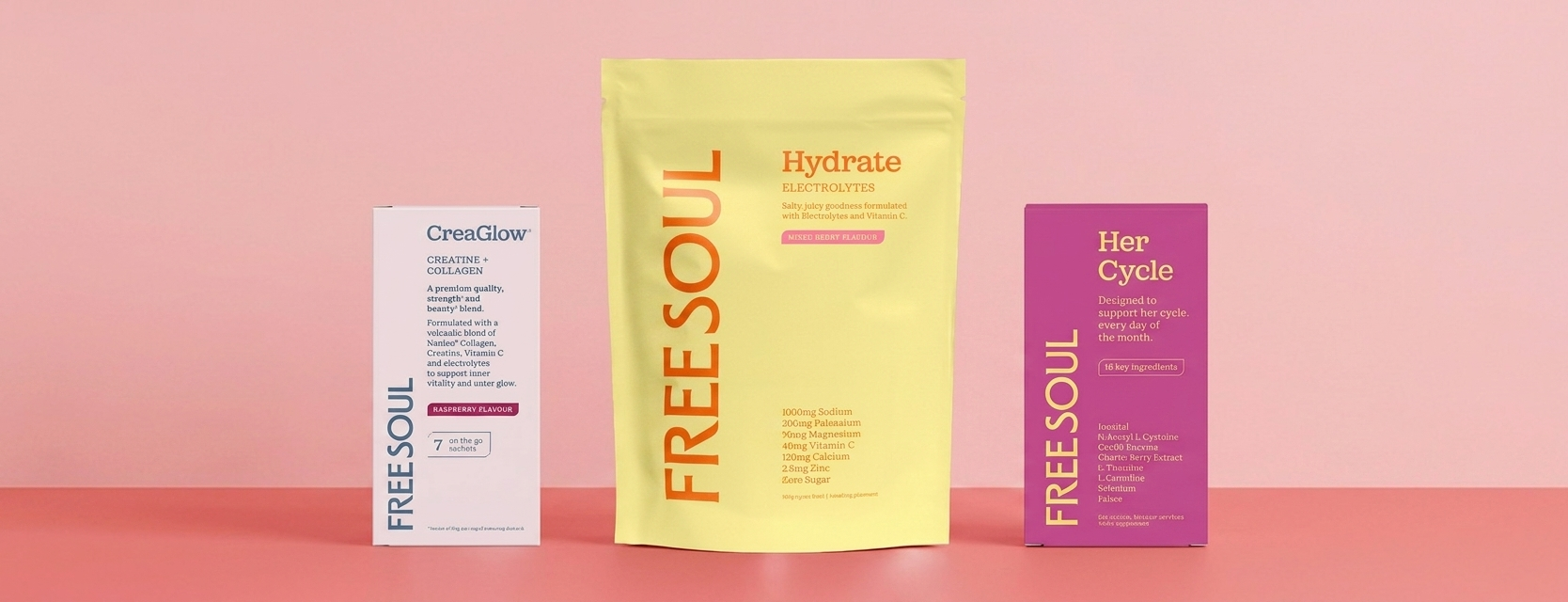
From greens powders to protein blends, discover the expert-backed Free Soul supplements women are reaching for – and why
Our top picks
The supplement world can feel noisy. One minute it’s collagen in your coffee, the next it’s greens powders, electrolytes and protein blends all over your feed. So how do you know what’s actually worth adding to your routine? With a little help from Natalie Rouse, Head of Nutrition at Free Soul, we’re breaking down some of the formulas women are reaching for right now – and why. Though we tend to think of healthy eating as a handful of lifelong rules to stick to (eat your five-a-day, don’t skip breakfast…), nutritional needs can shift more than we realise. Hormones fluctuate, stress levels change, sleep can become unpredictable and it can be hard to prioritise proper meals.
That’s why the foods and supplements that support you during a busy work period, intense training session or stressful month might look different to what works at other times. Making small, realistic adjustments to your routine can help support your body through those changing demands. Want to find the right fit for you? Natalie shares the supplements worth knowing about.
Why you should always take a food-first approach
When you’re worried about nutrient gaps, it can be tempting to fill your basket with every supplement promising more energy, better skin or improved focus. But while supplements can play a supportive role, Natalie explains that they work best alongside a balanced diet that includes a variety of whole foods, fibre and nutrients.
“A nutrient-dense diet that meets all your nutritional needs remains the gold standard for women,” Natalie explains. “However, UK nutrient data shows that, in reality, consistent nutrient gaps are common among busy women,11 which is why targeted supplements can play a helpful supportive role.”
Why women’s needs change over time
Ever noticed how some days you can power through on a rushed breakfast and caffeine, while on others you feel completely drained by mid-morning? “We tend to think of fluctuating hormones like oestrogen and progesterone in terms of our reproductive system, but women’s hormones also play a role in our glucose metabolism, and have a hand in things like lipid oxidation, appetite, recovery and central nervous system activity,” Natalie explains.
“As our hormones shift both cyclically across the menstrual cycle phases and progressively across the lifespan, our nutritional requirements aren’t static but continuously evolving all the time.” Add in changing stress levels, exercise routines, sleep and calorie intake (factors which all have a direct impact on our hormones),1 and it becomes easier to understand why your body may need different kinds of support at different times.
Supplement FAQs
Most supplements can be taken together but some nutrients compete for absorption. For example, iron and calcium are usually best taken at different times, as calcium may reduce how well iron is absorbed.7 Some supplements are also better taken with food, while others may work best when spaced out across the day. If you’re taking several supplements, it’s worth checking the label guidance and talking to a healthcare professional. Find out more on whether it matters when you take your supplements.
The best supplements for you will depend on your diet, lifestyle and health goals. Looking at areas like sleep, stress, exercise, hydration and nutrient intake can help you decide where extra support may be useful. If you think you may have a nutrient deficiency or you’re experiencing ongoing symptoms like fatigue, it’s important to speak to your GP or a healthcare professional.
It depends on your life stage, diet and lifestyle. In the UK, vitamin D supplementation is recommended during autumn and winter months, as it can be difficult to get enough from sunlight alone.8 Magnesium is good as contributes to normal muscle and psychological function,9 while protein becomes increasingly important for supporting muscle mass and recovery as women age.10
If you’re pregnant or trying to conceive, folic acid supplements are also recommended before and during early pregnancy to support healthy foetal development.12 Beyond that, it’s worth considering a blood test or speaking to a healthcare professional to help identify any potential nutrient gaps or deficiencies.
The final say
Understanding how your nutritional needs can shift over time is a helpful starting point when it comes to choosing the right support for your routine – whether that’s hydration, energy, recovery or hormonal health. That said, supplements work best alongside consistent habits: balanced meals, movement, good sleep and managing stress where possible. Once those basics are in place, targeted products can help support your wider wellbeing goals.
Want to learn more? Explore the link between hormone health and nutrition, or speak to one of our experts with a free 15-minute consultation for more personalised support.
Disclaimer – This article provides informational advice and is not a substitute for medical care. Working with experts for accuracy, we take great care to ensure the information is up-to-date and relevant. However, you should always consult your GP or healthcare professional before using supplements or alternative products, particularly if you have medical conditions or are under supervision.
1. Kim TW, Jeong JH, Hong SC. The Impact of Sleep and Circadian Disturbance on Hormones and Metabolism. International Journal of Endocrinology [Internet]. 2015 Mar 11;2015(591729):1–9. Available from: https://www.ncbi.nlm.nih.gov/pmc/articles/PMC4377487/
2. Deane CS, Cox J, Atherton PJ. Critical variables regulating age-related anabolic responses to protein nutrition in skeletal muscle. Frontiers in Nutrition. 2024 Aug 6;11.
3. Bauer J, Biolo G, Cederholm T, Cesari M, Cruz-Jentoft AJ, Morley JE, et al. Evidence-Based Recommendations for Optimal Dietary Protein Intake in Older People: a Position Paper from the PROT-AGE Study Group. Journal of the American Medical Directors Association [Internet]. 2013 Aug;14(8):542–59. Available from: https://www.sciencedirect.com/science/article/pii/S1525861013003265
4. Shrimanker I, Bhattarai S. Electrolytes [Internet]. National Library of Medicine. StatPearls Publishing; 2023. Available from: https://www.ncbi.nlm.nih.gov/books/NBK541123/
5. Suh SY, Bae WK, Ahn HY, Choi SE, Jung GC, Yeom CH. Intravenous Vitamin C administration reduces fatigue in office workers: a double-blind randomized controlled trial. Nutrition Journal [Internet]. 2012 Jan 20 [cited 2020 Dec 20];11:7. Available from: https://www.ncbi.nlm.nih.gov/pmc/articles/PMC3273429/#:~:text=Thus%2C%20intravenous%20vitamin%20C%20reduced
6. Wessels inga, maywald martina, Rink L. Zinc as a Gatekeeper of Immune Function. Nutrients [Internet]. 2017 Nov 25;9(12):1286. Available from: https://www.ncbi.nlm.nih.gov/pmc/articles/PMC5748737/
7. Lynch SR. The effect of calcium on iron absorption. Nutrition Research Reviews [Internet]. 2000 Dec 1;13(2):141–58. Available from: https://www.cambridge.org/core/journals/nutrition-research-reviews/article/effect-of-calcium-on-iron-absorption/900B25C68177A9DCEF384FBD840CF96F
8. NHS. Vitamins and minerals – Vitamin D [Internet]. Available from: https://www.nhs.uk/conditions/vitamins-and-minerals/vitamin-d/
9. Great Britain Nutrition and Health Claims Register. Magnesium authorised health claims [Internet]. [cited 2026 Apr 8]. Available from: https://www.gov.uk/government/publications/great-britain-nutrition-and-health-claims-register
10. Harris S, DePalma J, Barkoukis H. Protein and Aging: Practicalities and Practice. Nutrients [Internet]. 2025 Jul 28;17(15):2461. Available from: https://www.mdpi.com/2072-6643/17/15/2461
11. Derbyshire E. Micronutrient Intakes of British Adults Across Mid-Life: A Secondary Analysis of the UK National Diet and Nutrition Survey. Frontiers in Nutrition. 2018 Jul 19;5(55).
12. NHS. B Vitamins and Folic Acid - Vitamins and Minerals [Internet]. NHS. 2020. Available from: https://www.nhs.uk/conditions/vitamins-and-minerals/vitamin-b/
Related to this article