20% off €45 or 15% off €35
 Track an order
 Manage account
 Buy It Again
 Favourites
 Rewards
 Find a store


What’s the best food to eat before football? It can be tricky to balance nutrition with busy schedules – so we’ve scored expert insight from a sports nutritionist
Summary
1Best foods for football players
Alongside a balance of all the vitamins, minerals and nutrients you’d normally need, it’s a good idea to focus on carbs and protein.
2Football nutrition at a glance
Need your info quick? You’ll find much more on staying fuelled below, but here’s a quick guide to which macros to focus on.
3Nutrition for... after the match
Post-match is the time to optimise recovery – then you can go to your next training session feeling refuelled and with fewer aches.
From pre-match meals to post-game recovery, football nutrition can make a real difference to your energy, endurance and recovery – whether you’re playing Sunday league or training several times a week. Sports nutritionist and former performance nutritionist to Oxford United Emily Foster is on hand to coach us through the ultimate nutrition for football players.
Best foods for football players
“Your body needs the fuel to perform at an optimal level. Professional footballers can cover between nine and 13 kilometres in a 90-minute match and burn between 1,300 and 1,600 calories,” says Emily.1 But a proper diet is important, even if it’s just a kickabout: “Nutrition can play a big role in strength, speed, power, endurance and decision-making.” For example, one study showed that when footballers drank a carbohydrate and electrolyte solution, they covered a 33% greater distance during a drill than with a placebo.2 Alongside a balance of all the vitamins, minerals and nutrients you’d normally need, it’s a good idea to focus on carbs, protein and overall dietary patterns for sports:
- carbohydrates: brown rice and pasta, starchy veg and beans and lentils are all good examples of slow-releasing, complex carbohydrates. And carb-rich snacks like fruit, flapjacks, small portions of overnight oats or toast with peanut butter are all good ideas for fuelling your muscles before a match
- protein: meat, fish, beans and lentils are good to fit into every meal as a key source of protein. Eggs, protein shakes and bars, Greek yoghurt, beef jerky and nuts are all good protein-rich snacks too
- post-exercise nutrition: a combination of protein and carbohydrates after training can help replenish energy stores and support muscle recovery. Protein shakes are a convenient way to increase protein intake after exercise, but they're not essential – foods like yoghurt, milk-based smoothies, cheese, eggs and lean meats can all contribute towards your protein intake. Dairy foods also provide calcium, which supports normal muscle function and the maintenance of normal bones.3,4
Sound complicated? We recommend meal prepping, especially if you’ve got an evening kick-off or training after work. It’s also useful to build a few quick ‘go-to’ meals, where you already know the macros and can whip them up in a matter of minutes.
Football nutrition at a glance
Need your info quick? You’ll find much more on staying fuelled below, but here’s a quick guide to which macros to focus on before, during and after training from a nutritionist...
| Timing | What to focus on |
|---|---|
| Day before | Carbohydrates + hydration |
| 3-4 hours before | Balanced meal with carbs + protein |
| 30-60 mins before | Easy-to-digest carbs |
| Half time | Fluids + electrolytes + carbs |
| After match | Protein + carbohydrates + hydration |
What to eat... the day before the match
Also known as ‘match day minus one’, this is where Emily says your pitch performance actually begins. It’s also where any carb loading starts. “Maximise those high carbohydrate stores by eating foods like grains, pasta, rice, potatoes and bread. Prioritise them, but eat them alongside lean proteins, fruit, vegetables and healthy fats for balance,” Emily explains.
For match day prep, aim for half a plate of carbohydrates, a quarter of great quality lean protein and a quarter of fruit and veg: “Carbs are our bodies’ primary energy source, so we need them to maintain our level of intensity – but we also need protein for recovery and repair.”
Amino acids (the ‘building blocks’ of protein) are important for promoting muscle repair, recovery and growth too. “Some foods contain all our essential amino acids, while others you'll need to pair with other foods that contain different types of essential amino acids to be able to achieve a complete protein. A lot of people go for animal protein or whey protein because it’s already a complete protein. Some of my favourite plant-based complete proteins would be quinoa, soy products, hemp seeds and chia seeds.”
What to eat... on match day
When you get to match day itself, Emily and other football nutrition experts recommend having your pre-match meal three to four hours ahead of the game. “For your pre-match meal, focus on carbohydrate-rich foods again. You're trying to maximise those fuel stores in the muscles to delay fatigue during play,” Emily explains. So don’t skip breakfast or lunch and be sure to include a carb source, such as bread or porridge. You could add some protein too, so that you’re already prepping for the repair needed afterwards (more on this later).
You also want to ensure you’re hydrated. A study within elite football suggests dehydration could lead to cardiovascular strain, reduced cognitive function, higher risk of heat exhaustion and increased perception of effort.1 “This study also suggests that dehydration might reduce technical skills like dribbling or skilling past players on the pitch.”
What to eat... just before the whistle
According to Emily, post warm-up and pre-match is a great opportunity to grab a carb boost, ideally around 30-60g. “We're talking things like sports drinks, sports gels, dried fruit or fruit – a banana’s a good option. These can increase the sugars circulating within the blood and the muscles can take these sugars up straight away and use them for their fuel, before dipping into their stores within the muscles.”
Half-time nutrition tips
“Half time’s an opportunity to replenish lost fluids and get in some carbohydrates,” says Emily. To maximise your mid-match break, consider a sports drink – “then you’ve got fluids, electrolytes and sugars. Alternatively, an energy gel alongside some water with electrolytes is a good choice.”
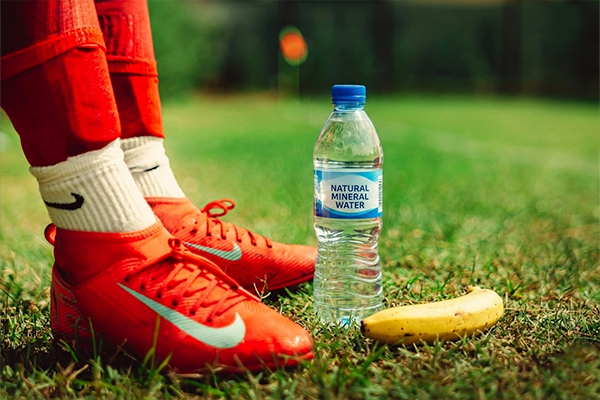
“I worked with an athlete who used to squeeze their energy gel into their water bottle and mix it up – basically creating your own sports drink. Or something like a banana, fruit or dried fruit alongside some water and electrolytes.” So that half-time orange slice from your school matches really was a good idea...
Nutrition for... after the match
Post-match is the time to optimise recovery – then you can go to your next training session feeling refuelled and with fewer aches. “Begin recovery by replenishing those fuel stores you’ve depleted, by consuming carbohydrates like sports drinks, fruit, oats and small sandwiches,” says Emily. “Throughout the rest of the day, about every hour post-match, consume a small amount of carbohydrates like a banana, an energy bar or some toast and jam.”
Then, add protein into the mix: “Protein is important because it supports muscle repair and adaptation following exercise. About three hours post-match, eat a meal made up of carbohydrates, a moderate amount of high-quality protein and some healthy fats like omega-3.” That could look like chicken and rice with an avocado salad, tuna pasta bake with veg or a tofu stir-fry with noodles, plenty of veg and a dollop of peanut butter in your sauce. And don’t forget plenty of fluids or a protein shake to keep you hydrated.
Nutrition tips for women and non-binary footballers
If you have heavy periods, your iron requirements might be higher – especially during your period. “Symptoms of low iron can include weakness, fatigue and trouble concentrating – so you can imagine how that might impact performance,” says Emily.5,6 Be sure to get plenty of iron in your diet from foods like poultry, fish, lean red meat, beans, lentils, spinach and dried apricots.5
Over to you: real players share their nutrition routines
Many of our H&B colleagues hold a wellness qualification – so we thought we’d ask them for their own energy-boosting ideas. Here’s what they eat and drink to be match fit...
- “My process starts the day before football. I prioritise eating foods rich in carbohydrates, like rice and bread, as well as lots of protein and water. Around an hour before, I’ll have a quick carby snack like fruit and also an electrolyte supplement.”* – Jahan, Ilford
- “I’ll have Weetabix with semi-skimmed milk a few hours before kick-off. This usually gives me enough energy to last a 90-minute game.” – Jake, Dover
- “H&B flapjacks on Sunday mornings, then sports gels and electrolyte tablets for during the match. I also have occasional cans of sports drink when I'm feeling a bit tired...” – Jake, Nottingham
* Electrolyte supplements aren’t essential for all players and may be more relevant during longer sessions, hot conditions or when sweat losses are high.
Football nutrition FAQs
Protein helps muscles repair, rebuild and recover after strenuous exercise. Everyone needs protein, but getting enough is particularly important if you do sports – aim for roughly 1.2 to 2g protein per kg of your body weight.7,8
Sports drinks can provide carbohydrates and electrolytes which may be useful during prolonged or intense exercise – particularly when sweat losses are high. However, they’re not always necessary. Water is often sufficient for shorter or lower-intensity sessions, and individual needs will vary depending on factors like exercise duration, intensity and environmental conditions.
Eggs are a great source of protein, which is important for muscle repair and recovery in sports. There’s no set amount of eggs a footballer should eat, but one medium egg provides about 7.2g protein.9 Everyone needs different amounts of protein depending on their weight, activity level and more – you can find out how much protein you need in our handy calculator.
The final say
Your football nutrition will depend on who you are and when you're playing, but a winning tip is to combine carbohydrates, protein and hydration. This will make sure a range of your body's needs are met.
Hungry for more footballing tips? Check out 24 hours with Jill Scott (our interview with the former Lioness) or discover our guide to bouncing back from sports injuries...
Disclaimer – This article provides informational advice and is not a substitute for medical care. Working with experts for accuracy, we take great care to ensure the information is up-to-date and relevant. However, you should always consult your GP or healthcare professional before using supplements or alternative products, particularly if you have medical conditions or are under supervision.
1. Collins J et al. UEFA expert group statement on nutrition in elite football. Current evidence to inform practical recommendations and guide future research. British Journal of Sports Medicine [Internet]. 2020 Oct 23; 55(8) [cited 2026 Jun 4]. Available from: https://bjsm.bmj.com/content/55/8/416
2. Williams C, Serratosa L. Nutrition on match day. Journal of Sports Sciences [Internet]. 2006 Aug [cited 2026 Jun 4]; 24(7): 687-97. Available from: https://www.researchgate.net/publication/7015995_Nutrition_on_match_day
3. European Commission. Characteristics [Internet]. European Commission [cited 2026 Jun 4]. Available from: https://ec.europa.eu/food/food-feed-portal/screen/health-claims/eu-register/details/POL-HC-6346
4. European Commission. Characteristics [Internet]. European Commission [cited 2026 Jun 4]. Available from: https://ec.europa.eu/food/food-feed-portal/screen/health-claims/eu-register/details/POL-HC-6342
5. NHS. Iron deficiency anaemia [Internet]. NHS [reviewed 2024 Jan 26; cited 2026 Jun 4]. Available from: https://www.nhs.uk/conditions/iron-deficiency-anaemia/
6. The Association of UK Dietitians (BDA). Iron [Internet]. BDA [reviewed 2024 Apr; cited 2026 Jun 4]. Available from: https://www.bda.uk.com/resource/iron-rich-foods-iron-deficiency.html
7. Egan B. Protein intake for athletes and active adults: Current concepts and controversies. Nutrition Bulletin [Internet]. 2016 Aug 14 [cited 2026 Jun 4]; 41(3): 202-13. Available from: https://onlinelibrary.wiley.com/doi/full/10.1111/nbu.12215
8. NHS. Malnutrition [Internet]. NHS [reviewed 2023 May 23; cited 2026 Jun 4]. Available from: https://www.nhs.uk/conditions/malnutrition/
9. Nutritics.com. Cited 2026 Jun 4.