20% off €45 or 15% off €35
Is this the new protein powder? Is collagen essential for recovery after sport?

Written byAmy Bonifas

Reviewed byAlex Thompson

To feel fit for your next workout, you need a plan in place – and this nutritionist says collagen may speed up and support your sports performance
Summary
1Can collagen help with joint pain?
A large 2023 review found that athletes taking 5-10g of collagen felt reduced pain and better joint flexibility.
2Collagen to keep you running for longer
According to new research, running might help stimulate your cartilage to grow and produce type II collagen.
3Collagen for building strength
Collagen can help to prevent age-related muscle loss but its big benefits are to do with bone strengthening.
You’ve probably heard about collagen’s role in skin health – but what about its place in your training routine? As more people take their workouts outdoors and training ramps up in the warmer months, interest in collagen for recovery is growing. So how does it compare to your usual protein powder – and when should you actually take it? Here, H&B’s Senior Nutritionist Alex Thompson – a specialist in sports nutrition – breaks down the types of collagen to know, how they may support your workouts1 and how to use collagen supplements as part of a practical, summer-ready routine (and of course during the winter months too).
The many faces of collagen
First, let’s break down how collagen works to better understand the potential benefits for sport and exercise lovers. “Collagen is one of your body’s key building blocks and it gives structure to your bones, skin, tendons, blood vessels and more,” says Alex. “It also plays a key role in repair and rebuilding tissues – it can help stimulate cartilage and bone to grow.”
"There are three main collagen types that support mobility when training"
While 28 different types of collagen have been identified according to the structure they form2 – who knew? – it’s mainly collagen types I, II and III that support mobility when training.3
- Collagen type I – “This is the most common type and gives your connective tissues the structure and ability to work alongside your muscles,” says Alex. “It’s hugely important for helping you stay active as you age and plays a role in repairing damaged tissue, too”
- Collagen type II – “Type II makes up the tissue that cushions your joints and bones – your cartilage,” says Alex. It’s made up of a tight network of fibres and gives your cartilage the strength and elasticity to withstand the pressure of physical activity4
- Collagen type III – Supporting the structure of your muscles, organs and arteries, type III plays an important role in the early stages of tissue repair – helping with the cell production stages of the process5
How to take collagen for your workout
We might blame our muscles when the post-workout ache sets in, but your connecting tissues are responsible too. “After weight training or a heavy training session, people tend to feel the worst soreness between the tendons and the muscle structure,” says Alex.
How to take collagen before outdoor exercise
Collagen can be taken before outdoor exercise in a way that suits your routine – whether that’s adding a collagen containing product to a drink or smoothie, taking capsules or using a ready-to-drink option around 30–60 minutes before exercising. It doesn’t just have to be taken at this time, but some research suggests taking collagen before exercise may help support connective tissues during activity.
“One study found that taking 3g of collagen daily for six weeks led to better muscle recovery after exercise,” says Alex.6 “But another piece of breakthrough research found that taking a higher dose of 20g/d before could make a difference in as little as nine days.”7 However, as these studies were conducted in small sample sizes (eight people in the first study), larger clinical trials are needed to confirm these results.
"Research suggests taking collagen proactively before aches and pains kick in could help you bounce back quicker"
How much collagen to take after exercising
In the study, looking into the effects of collagen peptides on muscle damage, participants took 20g of collagen seven days before and two days after performing an impressive 150 drop jumps.8 They not only reported reduced muscle soreness 48 hours after the exercise, compared to the placebo group, they also recovered quicker and showed improved performance.
“This is likely down to those ‘hero’ amino acids – glycine and proline,” says Alex. “The research also suggests you could try taking higher dose of collagen (10-20g) proactively before those aches and pains kick in, helping you bounce back quicker.” Win-win.
While these studies show promising outcomes for collagen supplementation in DOMS, more robust evidence via larger clinical trials is needed. Please refer to the product label on the acceptable dose of collagen as each product may vary. You should also speak to a healthcare professional before adding any new collagen containing products to your diet.
The difference between protein and collagen for workouts
Protein, particularly whey protein, supports muscle repair and growth due to its essential amino acid content, including leucine.8 While it’s often had after exercise, research suggests that we can get the most out of protein if taken within the window of a couple of hours before exercise (not just 30 minutes before) and its just as beneficial as having it immediately after.9 Of course, overall total daily protein intake is key, however.
Alex explains, “just as dietary protein supports muscle building and recovery, collagen may support connective tissues such as tendons and ligaments. These connect your muscles to your bones and help to stabilise your skeleton as you move. And while dietary proteins are packed with all the amino acids needed for muscle growth and repair, they’re lower in two particular ones – glycine and proline – which play a particular role in the structure of tendons, ligaments and cartilage,” explains Alex. And you guessed it; these are the amino acids that collagen is richest in.10
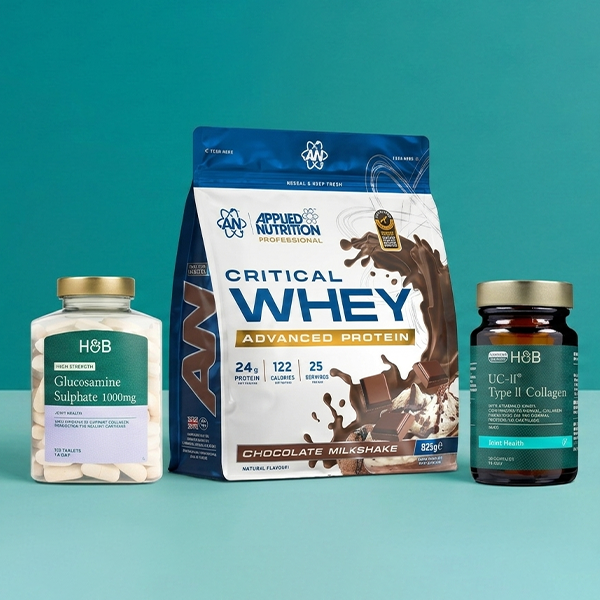
“Collagen with added vitamin C, works well with other protein sources as part of a training routine,” says Alex. So, if you're looking to support your muscles, bones and cartilage, try adding both powdered collagen and protein to your post-workout summer smoothie (which is so refreshing during the summer months). Collagen works best as support, particularly when combined with resistance training, movement, balanced nutrition and adequate sleep.
Can collagen help with joint pain and injuries?
Pain and injury happen to the best of us. 43% of athletes get at least one injury per season,11 and highly active people might be more likely to experience joint pain, according to researchers.12

The good news is that collagen might be able to help. “A large 2023 review found that athletes taking 5-10g of collagen felt reduced pain and better joint flexibility – reducing their injury risk,” says Alex.1 It also found that collagen containing products increased the length of pain-free activity and reduced the need for alternative pain relief by up to 59%.
Collagen could also be a game-changer for preventing future injuries, too. A study on athletes with chronic ankle injuries (one of the most common sport-related issues) found that taking 5g of collagen for six months lowered the number of future ankle sprains and injury risk overall.13 “Again, this is because collagen not only helps to stabilise your tendons, ligaments and cartilage, but collagen types I and III also signal to cells when tissue is damaged, helping to kick off and speed up the repair process.”
Can collagen help you run for longer?
We’ve all heard that running can be tough on your joints. But according to new research, running might help to stimulate your cartilage to grow, rather than wearing it out.14 A study of marathon runners found that the body produces an influx of type II collagen after they cross the finishing line, likely to manage inflammation and encourage repair.15
"According to one study, collagen supplementation might also help you fend off runner’s knee'"
Your cartilage is around 60% collagen16 and taking collagen containing products could potentially keep this natural shock-absorber stay healthier – helping your running stamina and performance in the long term.17 Collagen supplementation might also help you fend off one of the most common running complaints – runner’s knee. One study showed that 5g of daily collagen across 12 weeks improved activity-related knee pain in young athletes.18 Further studies looking at the dosage, type of collagen and duration is important, but this is a promising start.
Does collagen help build strength?
As an added bonus, collagen has an all-round strengthening effect. “Collagen can help to prevent age-related muscle loss, but its big benefits are to do with bone strengthening,” says Alex.18 A research analysis found that participants taking a collagen containing product had reduced the symptoms of osteoporosis and osteoarthritis, and the authors theorised that collagen might help to increase bone mineral density.19 However, they acknowledged that further studies in early diagnosis, duration and dosage is vital to get a better understanding of how collagen could have the most potential impact.
“As we get older, our connective tissues start to wear down, so when your natural stores start to decline, collagen could help to improve mobility and even build some muscle mass.” This is especially true if you’re very active, as you’ll be putting your body under more stress.
Collagen usage guide in a nutshell
- Be consistent: take collagen daily rather than just on workout days – this may help support joint and connective tissue health
- Typical daily amount: around 3–10g per day is commonly used, with some research exploring up to 20g for more intensive training periods but always follow the product label
- Before workouts: taking collagen 30–60 minutes before exercise (especially strength or high-impact training) may help support tendons and ligaments. Pair with vitamin C, which contributes to normal collagen formation
- After workouts: collagen can also be taken post-workout, often alongside protein, which may support overall recovery – think adding it to a smoothie or shake
- Pair with protein: collagen doesn’t replace protein. Use it alongside a complete protein source (like plant or whey protein) to support both muscles and connective tissue
- Choose your format: powders are easy to add to shakes, coffee or smoothies, drinks are a convenient and ready-to-go option, whilst capsules are simple if you prefer no taste
- Make it work for your routine: there’s no single ‘perfect’ time – what matters most is taking it in a way you’ll stick to
Collagen and workout FAQs
The best collagen for joint support is type II collagen, because it makes up about 90% of the collagen found in cartilage – the tissue that cushions your joints.20 Some supplements use undenatured type II collagen (UC-II) or hydrolysed collagen, which may help reduce joint pain and stiffness, especially in people with osteoarthritis.20
Yes, collagen may help support exercise recovery and an active lifestyle. Research suggests that collagen peptides can help reduce muscle stress from intense exercise, support muscle repair and potentially speed up strength recovery after workouts, which may help people stay consistent with training.21
A summer collagen routine is all about simple, consistent habits. This might include taking a daily collagen supplement alongside vitamin C, staying hydrated and eating a balanced diet with enough protein and fruit and veg. Regular movement can also support joints and connective tissue. With more sun exposure in summer, protecting your skin with SPF is just as important to help maintain your natural collagen levels.
The final say
Collagen might be best known as a beauty supplement, but its role goes beyond skin deep. As a key structural protein, it may help support joints, tendons and connective tissue involved in movement, with some emerging evidence suggesting it may also aid recovery when paired with regular training and adequate protein intake.
While it’s not a quick fix, adding collagen into a balanced routine could be a useful extra alongside your workouts. If you’re curious where to start, explore our edit of the best collagen supplements or discover the best collagen drinks to find a format that fits your routine.
Disclaimer – This article provides informational advice and is not a substitute for medical care. Working with experts for accuracy, we take great care to ensure the information is up-to-date and relevant. However, you should always consult your GP or healthcare professional before using supplements or alternative products, particularly if you have medical conditions or are under supervision.
1. Khatri M, Naughton RJ, Clifford T, Harper LD, Corr L. The effects of collagen peptide supplementation on body composition, collagen synthesis, and recovery from joint injury and exercise: a systematic review. Amino Acids [Internet]. 2021;53(10):1493–506. Available from: https://www.ncbi.nlm.nih.gov/pmc/articles/PMC8521576/y
2. Ricard-Blum S. The Collagen Family. Cold Spring Harbor Perspectives in Biology [Internet]. 2010 Dec 15;3(1):a004978–8. Available from: https://cshperspectives.cshlp.org/content/3/1/a004978.long
3. Wang H. A Review of the Effects of Collagen Treatment in Clinical Studies. Polymers [Internet]. 2021 Nov 9;13(22):3868. Available from: https://www.ncbi.nlm.nih.gov/pmc/articles/PMC8620403/
4. Type II Collagen - an overview | ScienceDirect Topics [Internet]. Sciencedirect.com. 2016. Available from: https://www.sciencedirect.com/topics/biochemistry-genetics-and-molecular-biology/type-ii-collagen
5. Mathew-Steiner SS, Roy S, Sen CK. Collagen in Wound Healing. Bioengineering. 2021 May 1;8(5):63.
6. Lopez HL, Ziegenfuss TN, Park J. Evaluation of the Effects of BioCell Collagen, a Novel Cartilage Extract, on Connective Tissue Support and Functional Recovery From Exercise. Integrative Medicine (Encinitas, Calif) [Internet]. 2015 Jun 1 [cited 2024 Jul 16];14(3):30–8. Available from: https://pubmed.ncbi.nlm.nih.gov/26770145/
7. Clifford T, Ventress M, Allerton DM, Stansfield S, Tang JCY, Fraser WD, et al. The effects of collagen peptides on muscle damage, inflammation and bone turnover following exercise: a randomized, controlled trial. Amino Acids. 2019 Feb 19;51(4):691–704.
8. Breen L, Churchward-Venne TA. Leucine: a nutrient “trigger” for muscle anabolism, but what more?. The Journal of Physiology. 2012 Apr 26;590(9):2065–6.
9. Aragon AA, Schoenfeld BJ. Nutrient timing revisited: Is there a post-exercise anabolic window? Journal of the International Society of Sports Nutrition [Internet]. 2013 Jan 29;10(1). Available from: https://www.ncbi.nlm.nih.gov/pmc/articles/PMC3577439/10. Wu M, Crane JS. Biochemistry, Collagen Synthesis [Internet]. Nih.gov. StatPearls Publishing; 2019. Available from: https://www.ncbi.nlm.nih.gov/books/NBK507709/
11. UK Sport. Battle against injury and illness [Internet]. www.uksport.gov.uk. 2012. Available from: https://www.uksport.gov.uk/news/2012/07/25/battle-against-injury-and-illness
12. Elite sport linked with osteoarthritis risk [Internet]. The University of Edinburgh. 2022. Available from: https://www.ed.ac.uk/news/2022/elite-sport-linked-with-osteoarthritis-risk
13. Dressler P, Gehring D, Zdzieblik D, Oesser S, Gollhofer A, König D. Improvement of Functional Ankle Properties Following Supplementation with Specific Collagen Peptides in Athletes with Chronic Ankle Instability. Journal of Sports Science & Medicine [Internet]. 2018 Jun 1;17(2):298. Available from: https://www.ncbi.nlm.nih.gov/pmc/articles/PMC5950747/
14. Miller RH, Krupenevich RL. Medial knee cartilage is unlikely to withstand a lifetime of running without positive adaptation: a theoretical biomechanical model of failure phenomena. PeerJ. 2020 Aug 5;8:e9676.
15. Hernández-Hermoso JA, Nescolarde L, Roca E, Revuelta-López E, Ara J, Bayes-Genis A. Marathon Running Increases Synthesis and Decreases Catabolism of Joint Cartilage Type II Collagen Accompanied by High-Energy Demands and an Inflamatory Reaction. Frontiers in Physiology. 2021 Oct 11;12.
16. Sophia Fox AJ, Bedi A, Rodeo SA. The Basic Science of Articular Cartilage: Structure, Composition, and Function. Sports Health: A Multidisciplinary Approach [Internet]. 2009 Nov;1(6):461–8. Available from: https://www.ncbi.nlm.nih.gov/pmc/articles/PMC3445147/
17. Martínez-Puig D, Costa-Larrión E, Rubio-Rodríguez N, Gálvez-Martín P. Collagen Supplementation for Joint Health: The Link between Composition and Scientific Knowledge. Nutrients [Internet]. 2023 Jan 1;15(6):1332. Available from: https://www.mdpi.com/2072-6643/15/6/1332
18. Zdzieblik D, Oesser S, Gollhofer A, König D. Improvement of activity-related knee joint discomfort following supplementation of specific collagen peptides. Applied Physiology, Nutrition, and Metabolism. 2017 Jun;42(6):588–95.
19. Porfírio E, Fanaro GB. Collagen supplementation as a complementary therapy for the prevention and treatment of osteoporosis and osteoarthritis: a systematic review. Revista Brasileira de Geriatria e Gerontologia [Internet]. 2016 Feb;19(1):153–64. Available from: http://www.scielo.br/scielo.php?script=sci_arttext&pid=S1809-98232016000100153
20. Rath L. Are Collagen Supplements Helpful for Arthritis? | Arthritis Foundation [Internet]. www.arthritis.org. 2022. Available from: https://www.arthritis.org/health-wellness/treatment/complementary-therapies/supplements-and-vitamins/can-collagen-supplements-help-arthritis
21. Inacio PAQ, Gomes YSM, Aguiar AJN de, Lopes-Martins PSL, Aimbire F, Leonardo PS, et al. The Effects of Collagen Peptides as a Dietary Supplement on Muscle Damage Recovery and Fatigue Responses: An Integrative Review. Nutrients. 2024 Oct 8;16(19):3403.